

Standard Mileage vs. Actual Expenses for Photographers: Which Tax Deduction Saves You More?
If you use your vehicle to photograph weddings, drive to portrait sessions, scout locations, meet clients, or pick up equipment, you may be able to deduct the business use of your vehicle.
But one question trips up many photographers:
Should I deduct the IRS standard mileage rate or my actual vehicle expenses?
The answer depends on how you use your vehicle, what it costs to own and operate, and which deduction method you're eligible to use.
Here's how each option works.
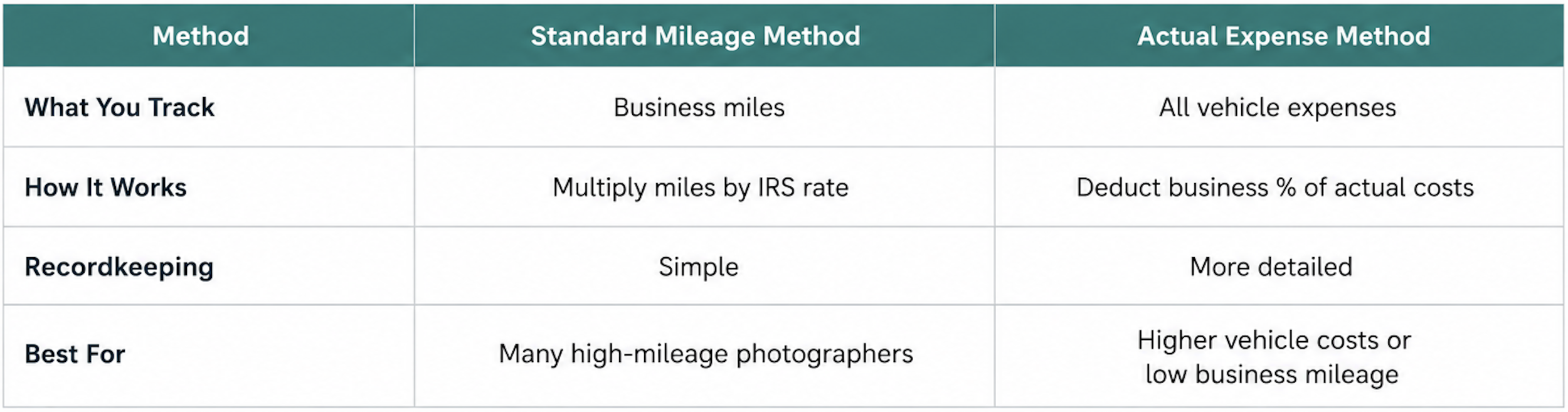
Standard mileage vs. Actual expenses
Option 1: The Standard Mileage Method
The standard mileage method is exactly what it sounds like.
Instead of tracking every dollar you spend on your vehicle, you simply record your business miles and multiply them by the IRS standard mileage rate for the period in which the miles were driven.
Keep in mind that the IRS generally updates the standard mileage rate each year, and in rare cases—such as 2022 and 2026—it may even make a mid-year adjustment. Always use the rate that applies to the dates your business miles were driven.
For example, if you drove 8,000 deductible business miles between July 1 and December 31, 2026, when the applicable IRS rate was 76¢ per mile, your deduction would be:
8,000 × $0.76 = $6,080
The calculation is simple, but you must still maintain adequate mileage records supporting the business purpose of each trip. The IRS recommends keeping mileage records at or near the time each trip occurs rather than trying to recreate them months later.
What you need to track
Date of each trip
Starting point and destination
Number of business miles driven
Business purpose
Total mileage for the year
Business-related parking fees and tolls
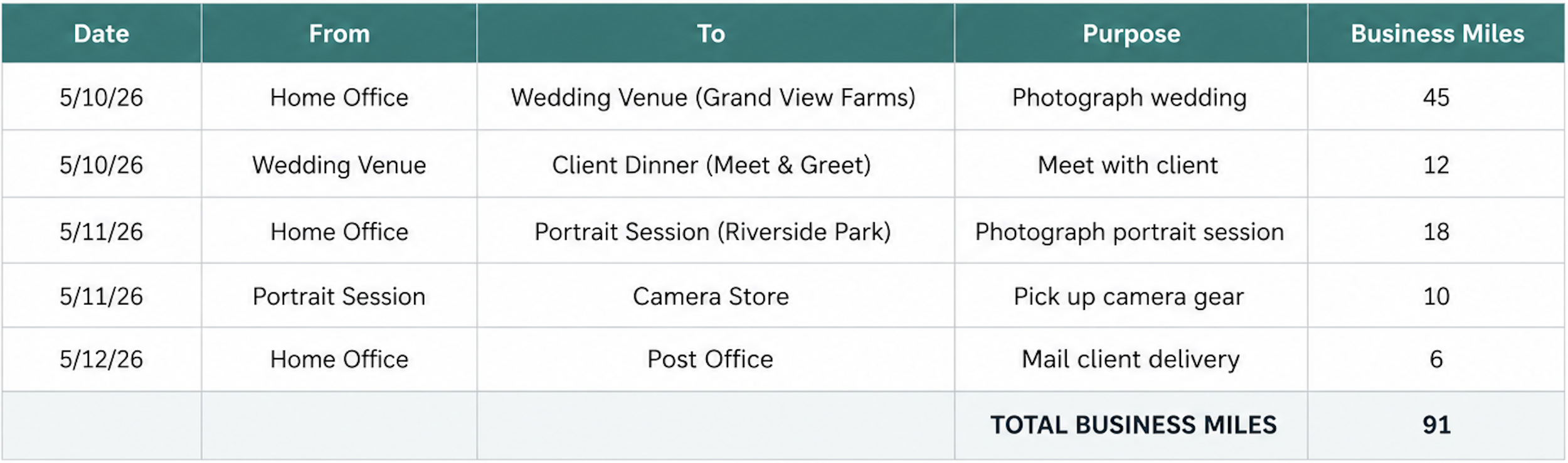
Photographers' mileage log example for tax deduction.
Note: Parking fees and tolls for business trips can generally be deducted separately even when the standard mileage method is used.
Mileage tracking apps like MileIQ, Everlance, and TripLog make this relatively painless.
View through the side window of a classic car showing the steering wheel and dashboard with reflections of people outside.
Option 2: The Actual Expense Method
Instead of using a mileage rate, you deduct the business percentage of your actual vehicle costs.
These expenses can include:
Gas
Oil changes
Repairs
Tires
Insurance
Registration
Lease payments (if leased)
Depreciation (if owned)
Important: If you are self-employed, the business-use portion of interest paid on a vehicle loan may be separately deductible even when you use the standard mileage method. The same expense cannot be deducted twice, and additional IRS rules apply.
You'll also need to determine what percentage of your total driving was for business.
For example:
Total miles driven: 20,000
Business miles: 8,000
Business use = 40%
If your annual vehicle expenses totaled $12,000:
$12,000 × 40% = $4,800 deduction
This is a simplified example. Depreciation limits, lease inclusion amounts, interest, parking fees, tolls, and other tax rules can affect the final deduction.
Which Method Usually Saves Photographers More?
The answer depends on your situation.
Standard mileage is usually better if...
You drive a lot.
Your vehicle is reliable and inexpensive to maintain.
You want simple recordkeeping.
You have lower operating costs.
You prefer an easier tax season.
Photographers who drive substantial business mileage may find the standard mileage method both practical and competitive, but the result depends on their vehicle costs and individual tax circumstances.
Actual expenses may be better if...
You purchased an expensive vehicle.
Your repair costs are unusually high.
Insurance costs are high.
You don't drive many business miles.
Your vehicle has significant depreciation.
Your actual operating costs are much higher than average.
A newer or more expensive vehicle may generate higher actual costs, but depreciation limits and other vehicle-specific tax rules can affect the deduction. The vehicle’s purchase price alone does not determine which method is better.
The numbers have to be compared.

A photographer leans over the hood of a parked SUV while taking photos beside a lake under an overcast sky.
Can You Switch Methods Later?
This is where many business owners get surprised.
If you own your vehicle and want to preserve the option of using the standard mileage method, you must generally choose standard mileage in the first year the vehicle is available for use in your business. You may switch to actual expenses in a later year, but special depreciation rules will apply. If you begin with actual expenses and claim MACRS depreciation, a Section 179 deduction, or special depreciation, you generally cannot use standard mileage for that vehicle later.
For leased vehicles, the rules are even stricter. If you choose the standard mileage method for a leased vehicle, you generally must continue using it for the entire lease period (including renewals).
Because these rules can affect future tax deductions, it's worth discussing your situation with your tax professional before making a decision.
You can also review the IRS's Publication 463, Travel, Gift, and Car Expenses, for detailed guidance on vehicle deductions, recordkeeping requirements, and the rules for choosing between the standard mileage and actual expense methods.

A photographer carrying a camera stands beside parked vehicles while preparing to photograph a scene.
What About Mixed Personal and Business Driving?
Most photographers use the same vehicle for both personal and business travel.
That's perfectly fine.
You simply need to keep accurate mileage records showing which trips were business-related.
Depending on the circumstances, deductible business transportation may include trips to:
Weddings
Portrait sessions
Venue walkthroughs
Client consultations
Networking events
Equipment pickups
Trips to the post office
Bank deposits
Office supply stores
“Bank deposits,” “post office,” and “office supply stores” are defensible when the trip is ordinary and necessary for the photography business. A personal trip does not become fully deductible merely because a small business errand is added to it.
Driving between business locations is generally deductible. Ordinary travel between your home and a regular place of business is generally nondeductible commuting. However, if your home office qualifies as your principal place of business under IRS rules, travel from that home office to another work location in the same business may be deductible. Special rules also apply to temporary work locations.
Good Recordkeeping Matters More Than the Method
Whether you choose standard mileage or actual expenses, documentation is essential.
The IRS expects you to keep records that support your deduction.
Good bookkeeping throughout the year makes tax season dramatically easier and helps ensure you don't miss legitimate deductions.
Which Method Is Right for Most Photographers?
There's no universal winner.
For many photographers, the standard mileage method offers the best combination of simplicity and tax savings.
For others—especially those with expensive vehicles or unusually high ownership costs—the actual expense method may produce a larger deduction.
The only way to know for sure is to compare both methods using accurate bookkeeping and mileage records.
Need Help Keeping Track?
Your vehicle can be one of the most valuable tax deductions available to your photography business—but only if your mileage and expenses are tracked accurately.
At Tidy Books, we help photographers stay organized all year long, track deductible expenses correctly, and provide clean financial records for their CPA. That means fewer surprises at tax time and more confidence that you're claiming every deduction you're entitled to.
Schedule a free consultation to learn how our bookkeeping services can help you spend less time sorting receipts and more time doing what you love.
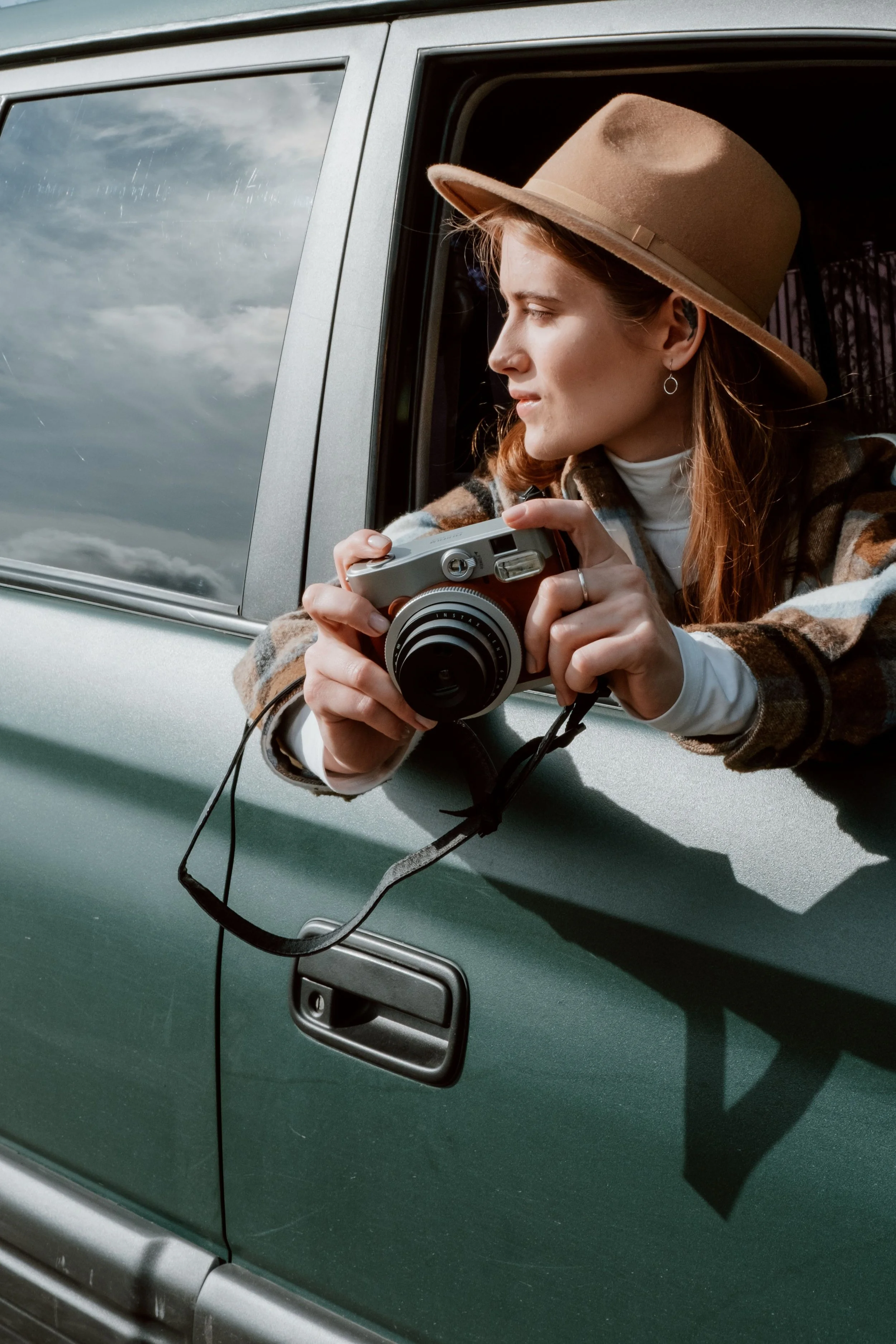
A photographer holds a camera out the driver's side window of a parked vehicle while looking toward a potential shooting location.
