


A simple Monday system to keep small bookkeeping tasks from becoming a slow-season clean-up project.
Monday arrives with a full list: answer inquiries, deliver galleries, confirm sessions, edit last week's work, and prepare for the next shoot. Bookkeeping is easy to push to Friday - and then to next week.
The problem is not that one receipt or one unmatched deposit takes hours to fix. The problem is that small questions pile up. A fifteen-minute weekly bookkeeping routine gives busy photographers a realistic way to catch those questions while the details are still fresh.
This routine is not a replacement for monthly reconciliation, financial reporting, or tax planning. It is a maintenance habit designed to keep current books current and make the deeper monthly work faster and more accurate.
Why a Weekly Bookkeeping Routine Works
The IRS does not require one specific bookkeeping app or filing system. It allows you to choose a system suited to your business as long as your records clearly show income and expenses. Supporting documents may include invoices, receipts, deposit information, account statements, and credit-card records.
Weekly timing matters most for items that are easy to forget. IRS Publication 463 says records should generally be created at or near the time of the expense or business use. It also states that a weekly log accounting for the week's activity is considered timely kept. That makes Monday a practical time to finish documenting the week that just ended.
BEFORE YOU START
If your books are already several months behind, fifteen minutes will not be enough to clean them up. Use this routine after the backlog has been addressed, or treat the first Monday as a quick assessment and schedule separate catch-up time. If you would rather not tackle the backlog yourself, Tidy Books can catch up your books for you. A free, no-pressure consultation can help you decide whether that support makes sense for your business.
Your 15-Minute Monday Bookkeeping Plan
Set a timer and move through the seven tasks below. The goal is not to solve every complicated issue. The goal is to keep routine activity organized, identify exceptions, and leave yourself clear notes before the details become harder to remember.
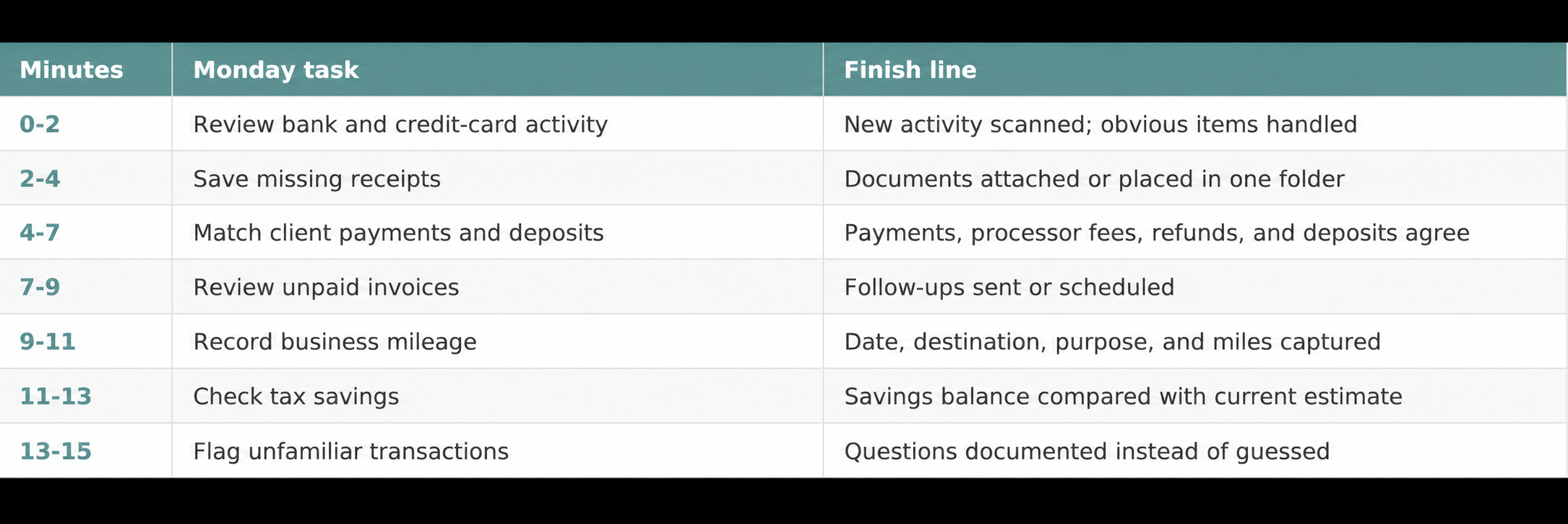
A 15-minute Monday bookkeeping schedule for photographers, with timed tasks for reviewing bank activity, saving receipts, matching client payments, checking unpaid invoices, recording mileage, reviewing tax savings, and flagging unfamiliar transactions.
1. Review Bank and Credit-Card Activity
Minutes 0-2: Open the business checking account and business credit card. Scan activity posted since the previous Monday. You are looking for obvious items that can be handled quickly, not completing a full bank reconciliation.
Watch for:
duplicate charges, refunds, bank fees, or returned payments;
personal purchases made accidentally with the business card;
new subscriptions, gear purchases, contractor payments, or unusually large expenses; and
transactions that are missing a clear payee or business purpose.
A bank feed is a useful starting point, but it is not the entire record. A line on a statement may show that money moved without showing what was purchased or why it was a business expense.
2. Save Missing Receipts and Supporting Documents
Minutes 2-4: Attach receipts to the related transactions or move them into one consistent digital folder. Check your email, wallet, camera bag, and text messages for anything received during the week.
The IRS says supporting documents for an expense should help identify the payee, amount, proof of payment, date, and a description showing the business nature of the purchase. One document does not always contain every detail, so a receipt, invoice, and account statement may work together.
Add a short note when the business purpose is not obvious. 'Client thank-you gift,' 'wedding-day parking,' or 'replacement memory card for fall sessions' will be far easier to understand than a mystery merchant name months later.

A photographer films an outdoor session, capturing the client work behind each payment, receipt, and business expense.
3. Match Client Payments and Processor Deposits
Minutes 4-7: Compare payments marked as collected in your client-management or invoicing system with activity in Stripe, Square, PayPal, your gallery platform, or another processor. Then match those payments to the deposits that reached the bank.
Do not assume the bank deposit equals the client's total payment. A $1,455 deposit may represent a $1,500 client payment less a $45 processing fee. Capturing only the net deposit can understate both gross income and processing expenses. A deposit may also combine several client payments or include adjustments for refunds or chargebacks.
For each deposit, confirm:
which client payment or payments are included;
the gross amount collected;
processing fees, refunds, or chargebacks; and
the date and bank account receiving the deposit.
If you are unsure how to classify a retainer, advance payment, refund, or unusual transaction for tax purposes, flag it instead of guessing. Timing and classification can depend on your accounting method and the facts of the transaction.
4. Review Unpaid Client Invoices
Minutes 7-9: Open your unpaid-invoice report. Separate invoices that are truly overdue from drafts, scheduled payment plans, and balances that are not yet due. Then send the follow-up that needs to go out today.
This step protects cash flow and keeps your records accurate. A full calendar does not mean the related cash has been collected. If your schedule is packed but your bank balance tells a different story, read Your Photography Calendar Is Full—So Why Does Cash Still Feel Tight?.
5. Record Business Mileage
Minutes 9-11: Enter every business drive from the previous week before the locations blur together. For each trip, record the date, business destination, business purpose, and miles driven. Keep the total mileage for the year as well.
Possible photography-business trips include driving to a client session, wedding venue, supplier, bank, professional event, or another temporary business location. Do not label every drive as business mileage. Ordinary commuting and mixed personal-business trips can require different treatment.
IRS Publication 463 specifically recognizes a weekly log as timely kept when it accounts for the week's use. Your Monday job is to preserve the facts - the miles, date, destination, and purpose. Your tax professional or software can apply the correct deduction method and rate for the applicable period.
Want a deeper comparison? Read our related guide: Standard Mileage vs. Actual Expenses for Photographers: Which Tax Deduction Saves You More?
If you tracked business driving during 2026, remember that two different mileage rates apply. Read The IRS Just Changed the Mileage Rate Mid-Year—Here’s What Photographers Need to Know for the split-year details.
6. Check Tax Savings
Minutes 11-13: Check the balance in the account or subaccount you use for taxes. Compare it with your most recent estimated-tax calculation and note whether business income has changed enough to justify a new estimate.
Federal taxes are generally pay-as-you-go. The IRS says individuals, including sole proprietors, partners, and S corporation shareholders, generally make estimated tax payments if they expect to owe $1,000 or more when the return is filed. The correct amount is not one universal percentage for every photographer. It depends on income, deductions, credits, entity structure, withholding, and other household tax information.
Money moved into a tax savings account has not been paid to the IRS. It is only reserved until you submit the payment. If your bookings, profit, or other household income changed materially, use the current Form 1040-ES worksheet or ask your tax professional to update the estimate.
Need a fuller explanation? Read Quarterly Taxes for Photographers Explained.
7. Flag Unfamiliar Transactions
Minutes 13-15: Review anything you could not confidently identify. Add the merchant, date, amount, and a short note about what you have already checked. Leave the transaction uncategorized rather than guessing.
An unfamiliar charge may be a legitimate auto-renewal, a duplicate, a personal purchase, a processor adjustment, or fraud. Check the receipt, subscription list, processor report, or calendar while the week is still recent. If it remains unclear, keep it flagged for follow-up instead of allowing it to disappear into the wrong category.
Stop When the Timer Ends
The routine works because it has a clear boundary. When fifteen minutes ends, place unresolved items on a short follow-up list. If the same issue appears every week, improve the system instead of extending Monday bookkeeping indefinitely.
For example, create one receipt email address, connect the correct processor feed, rename confusing bank rules, or ask clients to use a consistent payment method. The best weekly routine gets shorter as the underlying process gets cleaner.
What This Weekly Routine Does Not Replace
A fifteen-minute check-in is helpful, but it does not replace:
monthly bank and credit-card reconciliations;
reviewing the profit and loss statement and balance sheet;
payroll, sales-tax, 1099, or other filing responsibilities;
calculating and submitting estimated-tax payments;
correcting months of inaccurate or incomplete books; or
professional guidance for complicated tax or accounting questions.
How to Make the Routine Stick
Choose a time you can realistically maintain. That may be Monday morning before editing begins, immediately after school drop-off, or the first quiet point in your workday. If bookkeeping is something you dread, do it first so it is not looming over the rest of your week.
Then make the setup repeatable:
Use the same fifteen-minute calendar block every Monday.
Keep your bank, card, processor, invoicing system, and receipt folder in one browser bookmark folder.
Keep one short follow-up list so unresolved items do not get lost.
Let the routine be short. Save analysis and major corrections for a separate appointment.
Your Monday Bookkeeping Checklist
[ ] Review new business bank and credit-card activity
[ ] Save and attach missing receipts or supporting documents
[ ] Match client payments, processor activity, and bank deposits
[ ] Review unpaid invoices and send needed follow-ups
[ ] Record business mileage with date, destination, purpose, and miles
[ ] Compare tax savings with the latest estimate
[ ] Flag unfamiliar transactions and leave a clear follow-up note

A photographer arranging and photographing products in a professional studio surrounded by lighting equipment.
The Bottom Line
Good bookkeeping does not have to take over your Monday. Fifteen focused minutes can help you preserve receipts, document mileage, connect client payments to deposits, follow up on unpaid invoices, and spot questions before they become expensive clean-up work.
The routine is intentionally small. Its real value comes from repeating it every week - especially during busy season, when a full photography calendar makes financial details easier to overlook.
For a more complete seasonal review, use our Fall Busy Season Bookkeeping Checklist for Photographers.
Still spending far more than 15 minutes trying to untangle your books?
That usually means the issue is not your Monday routine. Your books may need a clean-up, a better system, or consistent monthly support. Tidy Bookshelps photographers turn scattered financial activity into organized, decision-ready books.
Tidy Books provides bookkeeping, not tax or legal advice; tax treatment varies by situation.
